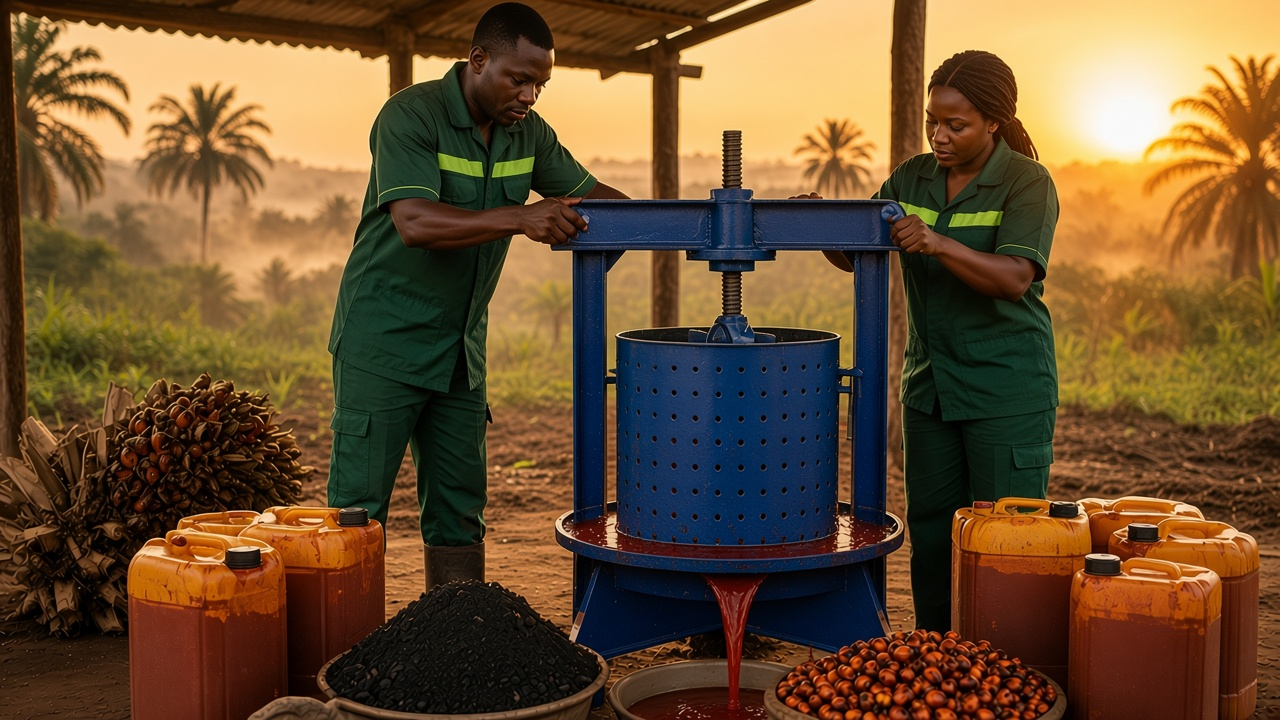
For palm oil, the value chain starts from the palm tree. The fruits are processed for red palm oil, leaving chaff and palm nuts. Crack the nut: you get the seed and the shell. For farming communities, the shells are typically waste. Some companies burn them in boilers. We've found they can also produce biochar and return to the soil.
About ten years ago, my cofounders and I moved into rural palm-processing supply chain work in Nigeria, buying from smallholders. Nobody handed us a diagram of how this works. This is what I figured out on the ground.
Nigeria's palm oil, by the numbers
Nigeria is the world's fifth-largest palm oil producer.
The same USDA data shows Nigeria has about 3.2 million hectares of palm harvested, the third-largest area in the world. So Nigeria is third by land but fifth by oil.
Most of that oil doesn't come from big plantations. The FAO notes that smallholders produce about 80% of Nigeria's output, and the PIND Foundation gives the same figure for the Niger Delta-centred industry.
The smallholder side: from wild grove to Lagos
Smallholders own wild groves of palm trees, held by individuals or families or shared by communities, similar to how a small American farmer may own a grove of pine trees or oak trees. They harvest them with laborers.
They have small transportation methods to bring these palm fruit bunches to a central location, being a mill. They have all the processing equipment there, a small generator, and laborers running the operation. That's how they produce the red palm oil.
The palm oil is put into jerry cans, these containers that are yellow in color and about 25 liters. Researchers price it the same way: a 2025 survey of palm oil wholesalers in three Port Harcourt markets compared the average wholesale price of a 25-litre jerry can (Agbagwa et al., European Modern Studies Journal).
These red palm oil jerry cans are sent to Lagos. They're essentially sent into the cities, where people love using palm oil in everything from their soups to their yam, and a few other things.
| Stage | Where it happens | Who does it | What moves on |
|---|---|---|---|
| Harvest | Wild groves | Smallholders and their laborers | Palm fruit bunches |
| Transport | Grove to a central mill | Small transportation methods | Palm fruit bunches |
| Processing | The mill, with a small generator | Laborers running the operation | Red palm oil, plus chaff and palm nuts |
| Packing | At the mill | The mill | Oil in yellow jerry cans of about 25 liters |
| Market | Lagos and other cities | Households | Soups, yam, and a few other things |
| Part of the palm fruit bunch | What it is | What it typically becomes |
|---|---|---|
| Red fruit flesh | The oily outer layer of the fruit | Red palm oil |
| Chaff / pressed fibre | What's left of the flesh after squeezing | Waste material. Small mills may press it again for a lower-grade oil used in soap; large mills burn it in their boilers |
| Empty bunch | The stalk the fruits grew on | Used by small processors as cooking fuel |
| Palm nut → kernel | The actual seed on the inside | Usually dried and sold to operators who make palm kernel oil |
| Palm nut → shell | The hard casing around the seed | Waste, boiler fuel, or biochar (see below) |
Cracking the nut: kernel and shell
Palm nuts basically can be cracked like a walnut. When you crack open the nut, you have the actual seed on the inside (the palm kernel), and then you have the shell.
The shell is not a small fraction. A study that weighed everything coming through ten smallholder mills in the Niger Delta found palm kernel shell made up 10.0–18.8% of the fresh fruit bunch weight for Dura palms and 6.8–7.5% for Tenera palms (Ohimain, Izah and Obieze, 2013).
In that same study, the shell outweighed the kernel in both varieties. The authors note that Dura, the thick-shelled variety, covers about 80% of oil palm plantings in the Niger Delta, which means more shell per bunch.
Where the shells end up today
For farming communities, the shells are typically waste. A lot of the communities actually end up dumping the shells for years. They didn't do very much with them.
Over time, more people have begun using them for fuel or burning them a little bit. Over the years some companies have been using them in their boilers, heating them up.
That's standard in big mills: the FAO describes how large-scale mills use recovered fibre and nutshells to fire their steam boilers and generate electricity for the mill.
| Where the shells go | Who does it | What happens to the carbon |
|---|---|---|
| Waste pile, or burned in the open | Many farming communities | Released as smoke and CO2 |
| Road filling | Some smallholder mills, to upgrade access roads | Stays on the road |
| Boiler fuel | Large mills and some companies | Burned for heat, released as CO2 |
| Biochar | What we're doing at BIG | Locked into a stable solid and returned to the soil |
What we found: shells can go back to the soil
But we are very excited about this new opportunity to turn the shells into biochar. What we've found is that the shells are a great heat source, but they can also be leveraged to produce biochar and return back to the soil as a soil health enhancement. If you want to know how the process itself works, we covered it in What Is Biochar and How Is It Made from Sawdust and Palm Shells?
As a soil health enhancement, biochar actually enables the palm trees to grow and yield even more bountiful harvests. Other agricultural crops can also grow a lot better.
For example, in Cross River we've seen that we've been able to apply biochar with a number of different crops and see enhanced yields. Results depend on the soil and the crop, which we're honest about in Biochar: What It Can and Can't Do.
So that's how you go from a palm tree, to red palm oil, to a cracked nut, to a shell that goes back to the soil. There's also a carbon side to keeping those shells out of the fire, covered in How to Get Carbon Credits from Agricultural Waste in Nigeria and West Africa.
Have palm kernel shells or other agricultural waste at your facility? Talk to BIG.