Earlier this month, China Daily reported a milestone the biochar industry should not scroll past. Researchers at the Institute of Environment under the Hefei Comprehensive National Science Center — after more than a decade of work — unveiled a one-step catalytic dry process for converting agricultural and forestry biomass into biochar at genuinely industrial scale: a single high-pressure carbonization unit can now produce over 50,000 tonnes of biochar a year.
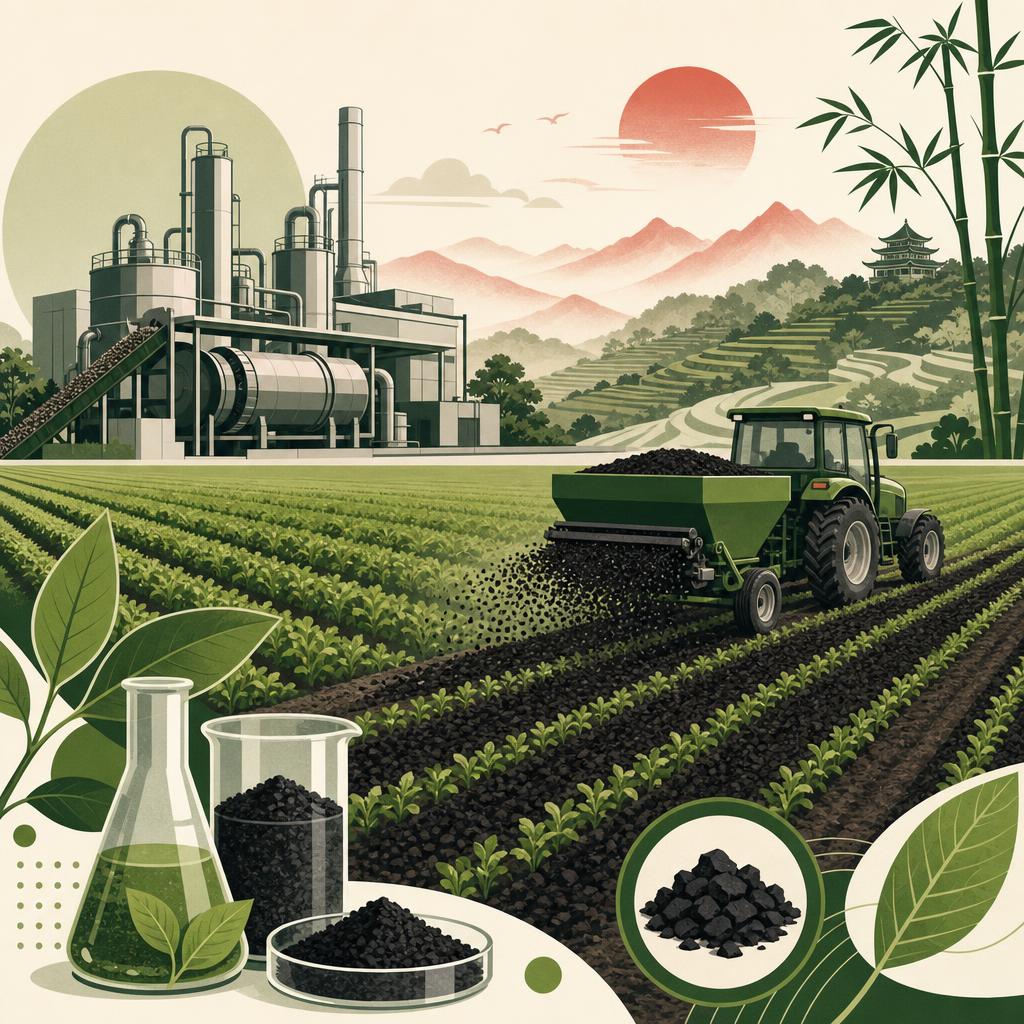
For context, most of the world's biochar is still made in small, distributed units — container-scale pyrolyzers, kilns, retrofit systems measured in hundreds or low thousands of tonnes per year. One unit doing 50,000 tonnes annually is the output of an entire mid-sized industrial facility, from a single machine. The technology has reportedly already been deployed across multiple Chinese cities.
What the breakthrough actually solves
The Hefei team says the process addresses the four bottlenecks that have held traditional biochar production back for decades:
- Low yield — more of the biomass ends up as usable char.
- Inconsistent quality — a catalytic, controlled process rather than variable batch burns.
- High energy consumption — the "dry" process avoids energy-hungry pre-treatment.
- Pollution — cleaner conversion than open or semi-controlled carbonization.
And the applications go beyond soil. The team has developed functional biochar-based materials for energy storage, environmental adsorption, and catalysis — and a spinoff project in Bozhou, Anhui province, is advancing rapidly on producing green aviation fuel from biochar.
Why this matters for the global biochar market
Our honest read, in five points:
- It sets a new efficiency bar. Every pyrolysis equipment maker — and every project developer choosing equipment — will now be measured against what a one-step catalytic process can do on cost per tonne.
- Cheaper supply could pressure margins. If low-cost Chinese biochar goes global, producers everywhere will feel it in the price of physical char.
- More supply could soften credit prices. A large new source of biochar — if it pursues certification — adds volume to a carbon credit market where supply, not demand, has so far been the constraint.
- The jet-fuel channel is new demand, not just new supply. Green aviation fuel from biochar hints at an entirely separate revenue stream for the industry — one that could absorb enormous volumes if it works at scale.
- This is market overlap, not head-to-head competition. China's feedstock is Chinese crop and forestry residue; its deployments serve Chinese cities. West African palm kernel shells, cashew shells, and sawdust still have to be processed where they are — carbon removal follows the feedstock, and feedstock does not cross oceans economically.
The three-to-five-year lens
The news is eight days old, and technology transfer out of a national science institute does not happen overnight. Nothing about this changes what a processor in Nigeria or Côte d'Ivoire should do this year: residues that are burned or dumped today are still worth converting into certified carbon revenue with the equipment that exists now.
But it is a clear call to action on a three-to-five-year horizon. Production technology will keep improving, and the players who track those improvements — and adopt them early when they become accessible — will hold the cost advantage when higher-efficiency processes go mainstream. That is how we are treating it at BIG: watch the technology closely, engage with it early if it proves out, and keep building certified supply in the regions where the feedstock actually is.
The takeaway
China just demonstrated that biochar can be an industrial commodity, not a niche product. That validates the entire thesis — biomass waste is a resource, at national scale — while raising the bar for everyone producing it. The winners of the next five years will be the ones who combine the best available conversion technology with the cheapest, most abundant feedstock. West Africa has the feedstock. The technology race is now officially on.
Source: Xinhua via China Daily (July 8, 2026), Chinese scientists turn farm waste into high-value biochar in green tech breakthrough. Figures are as reported by the Institute of Environment, Hefei Comprehensive National Science Center.