The carbon removal market runs on announcements — new facilities, funding rounds, future contracts. What it rarely shows is proof. This week, the market data platform CDR.fyi published something different: a map of every durable carbon removal project in the United States that has actually delivered — 40 certified projects, together issued credits for roughly 850,000 tonnes of net CO₂e removed, all independently verified on public registries.
We read the full report — Mapping Certified Durable Carbon Removal in the United States — so you don't have to. Here is what the data says, and why it matters enormously for palm, cashew, and timber processors in Nigeria and across West Africa.
The headline numbers
- 40 certified projects across 22 US states have received carbon removal credit issuances.
- 850,000 tonnes of net CO₂e removals issued between 2022 and mid-2026.
- Annual issued credits grew from 29,000 tonnes in 2023 to 460,000 tonnes in 2025 — a compound annual growth rate of roughly 298%.
- Biochar accounts for 24 of the 40 projects — more than every other carbon removal method combined.
Certification is the important word in all of that. These are not press releases about facilities that might exist in 2030. These are projects that produced carbon removal, submitted it to independent auditors, and had credits issued on public registries. It is the clearest picture available of which carbon removal technologies actually work in the real world today.
Biochar is not a promising method. It is the leading one.
Of every durable carbon removal pathway — direct air capture, enhanced weathering, ocean alkalinity, bio-oil injection — biochar is the one that has moved furthest beyond the lab. CDR.fyi attributes biochar's dominance to three things: mature technology, established certification methodologies, and widespread availability of biomass feedstock.
That last point deserves a second read. The single biggest factor deciding where America's certified carbon removal projects got built was not venture capital, not universities, not tech hubs. It was where the feedstock is.
Carbon removal follows the feedstock — not the cities
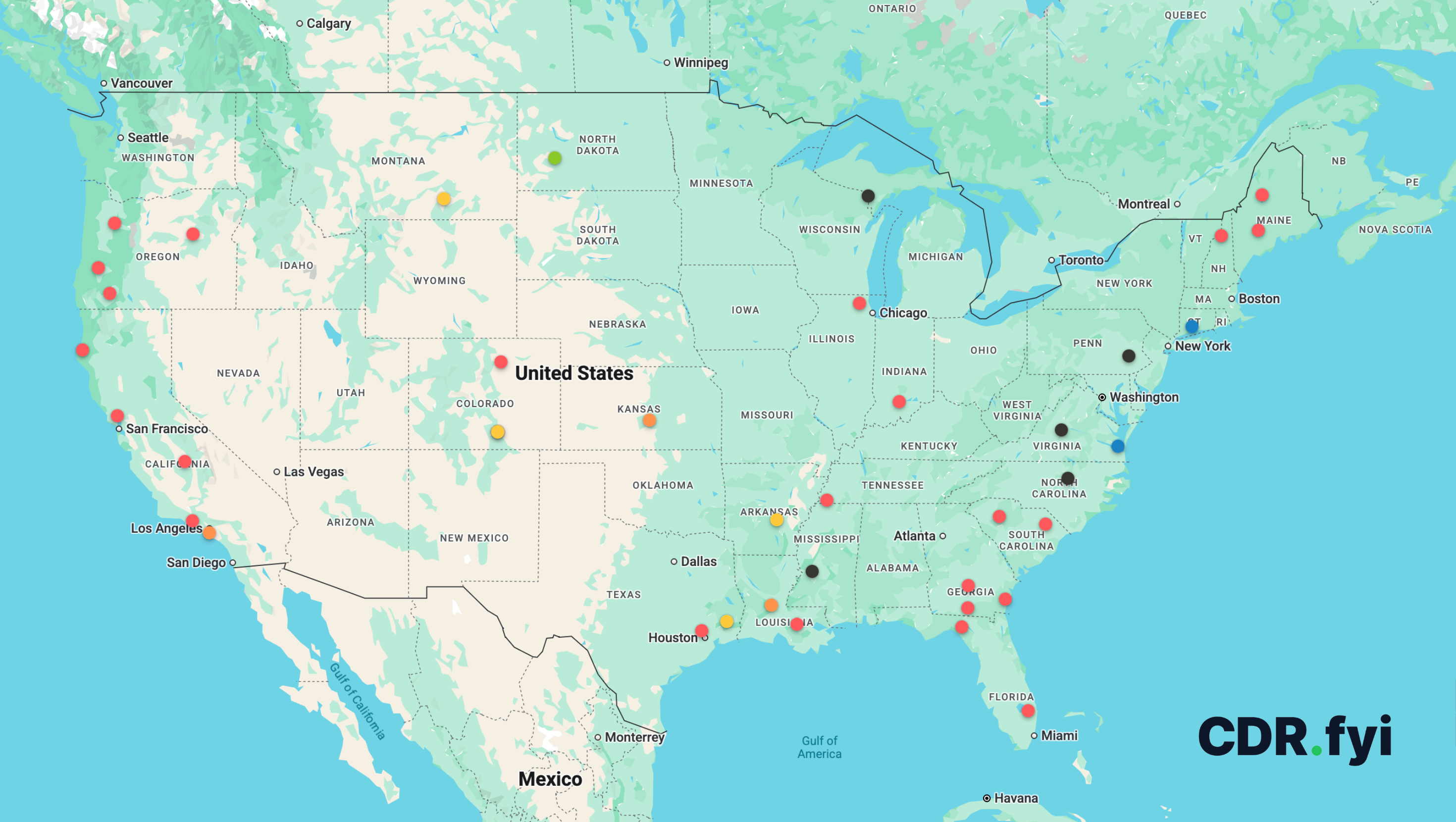
The report's most striking finding is geographic. Certified projects did not cluster in San Francisco or New York, where the credit buyers sit. They followed sawmills, farms, and mines:
- Forestry and wood residues are the dominant feedstock — sawdust and offcuts from sawmills, lumber mills, and pulp facilities.
- Agricultural residues come next — rice husks, nut shells, sugarcane bagasse, poultry litter.
- 70% of certified projects are in rural areas, and nearly half sit in counties with fewer than 100,000 people.
In CDR.fyi's words, these projects "build upon existing forestry, agriculture, mining, waste management, and manufacturing industries by creating new value from existing resources and infrastructure." Carbon removal plants are built next to the mill, not next to the buyer.
Now look at West Africa through that same lens
Everything the report identifies as a precondition for certified carbon removal exists in Nigeria and West Africa — at greater concentration than in most of the United States.
Nigeria's palm oil mills generate palm kernel shells by the tens of thousands of tonnes. Cashew processors in Nigeria, Côte d'Ivoire, Ghana, and Benin discard shells that carry some of the highest carbon-conversion factors of any feedstock — cashew shell biochar generates around 2.31 tonnes of CO₂e per tonne produced. Timber operations pile up sawdust exactly the way American sawmills do. These are the same "rural, industrial, feedstock-rich" conditions the US map rewards — and the residues here are largely burned or dumped today.
The US data also shows what the entry point looks like. Of the 40 certified American projects, 33 issue fewer than 5,000 tonnes of credits per year. Only one exceeds 25,000 tonnes annually. Certified carbon removal is currently an industry of many distributed, mill-scale projects — not a handful of mega-facilities. A single mid-sized West African processing site fits that profile precisely.
What certification actually means for a processor
The 850,000 tonnes in this report only count because independent auditors verified them. That is the bar. A pyrolyzer in a yard produces char; a registered, verified project produces revenue.
The path runs through certification: lab analysis of the biochar's carbon content and stability, ongoing MRV (monitoring, reporting, and verification), and credit issuance on a registry that buyers trust. It is the same machinery behind every project on the US map — and it is the part BIG handles for its partner factories, under the European Biochar Certificate and Rainbow standard, while the processor supplies feedstock and collects a revenue share.
The takeaway
The United States has just shown, with audited data, that biochar is the workhorse of durable carbon removal — and that the winning projects are built in small industrial towns, on top of existing mills and farms, close to feedstock. Buyers like Microsoft and Google are already purchasing biochar credits by the hundreds of thousands of tonnes, and supply — not demand — is the constraint.
West Africa's mills hold the feedstock that map is drawn around. The processors who convert their shells, husks, and sawdust into certified removals in the next two years will be the verified suppliers those buyers lock in before 2030.
Source: CDR.fyi (July 14, 2026), Mapping Certified Durable Carbon Removal in the United States, prepared by Tank Chen and the CDR.fyi team. All figures and images are theirs; data is drawn from publicly listed registry issuances as of June 20, 2026.