In Abuja last week, ECOWAS convened a three-day workshop to validate the framework for a regional carbon market platform across West Africa. Delegates from member states, development partners and technical institutions went through the draft article by article.
Buried in the coverage is a sentence that should interest anyone running an industrial site in the region. Setting out where West Africa's carbon potential lies, the ECOWAS Commissioner for Economic Affairs and Agriculture, Dr Kalilou Sylla, named forests, agricultural land, mangroves and degraded landscapes.
Read that list again. Every item on it is a place. Not one of them is a factory.
What is being decided
This is not a conference. ECOWAS has been running a process since 2024 to establish a harmonised regional carbon framework, and the Abuja sessions were the point at which the draft went under technical and legal scrutiny before adoption. Participants worked through the platform's scope, its technical architecture, the regional carbon register and the transaction mechanisms, and examined how the framework aligns with the ECOWAS Regional Climate Strategy and with Article 6 of the Paris Agreement.
Scope, register, transaction mechanisms. Those three things determine which projects can exist inside the platform and which cannot. A methodology that is not contemplated when the register is designed does not get added later as a matter of course. It gets added after somebody spends two years arguing for it.
The financing rationale is not in dispute. ECOWAS puts the region's climate finance needs at 294 billion dollars, drawing on its 2022 Regional Strategy for Access to and Mobilisation of Climate Finance. Regional temperatures are projected to rise by between 1.5 and 3 degrees by 2050, and the World Bank estimates that nearly 32 million people in the region could be internally displaced by climate impacts. Nobody at that workshop was arguing about whether West Africa needs carbon finance.
The question is what the framework will recognise when it arrives.
The gap between the list and the residue
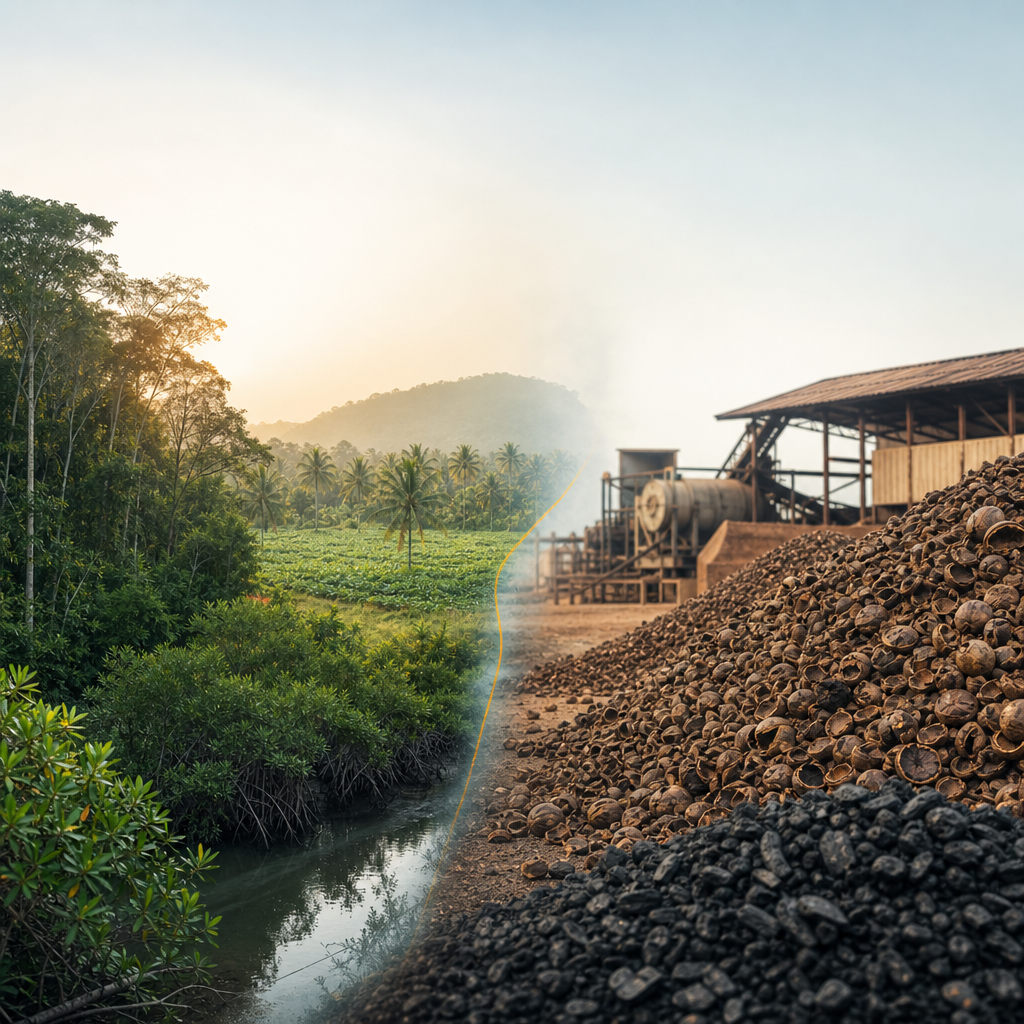
West Africa's agro-processing sector generates enormous quantities of dry, high-carbon residue that sits in one place. Palm kernel shells in Nigeria. Cashew shells and shell cake in Côte d'Ivoire and across the region. Sawdust and timber offcuts wherever there is a mill. This material accumulates at single sites in steady volumes, and much of it is currently a disposal problem rather than an asset.
None of that is a forest, agricultural land, a mangrove or a degraded landscape. It is a pile behind a building.
That distinction matters more than it might appear, because land-based and residue-based carbon projects are counted in fundamentally different ways. A land-based project measures a change across an area over time, which requires assumptions about what would have happened otherwise and monitoring across a wide geography. A residue-based project measures mass at a fixed point. Feedstock is weighed going into a reactor and biochar is weighed coming out. The verification apparatus is different, the data requirements are different, and the register entries look different.
A framework designed around the first will not automatically accommodate the second. It may not exclude it deliberately. It will simply have been built without it in mind, which produces the same outcome by a slower route. The difference between those approaches is explored in our comparison of land-based and measurement-based carbon credits.
Why the timing is the whole point
There is a version of this argument that is easy to dismiss as complaining, and it is worth separating from the version that is useful.
The useful version is about cost. Getting a category recognised while a framework is in article-by-article review costs a submission and a technical argument. Getting it recognised after adoption costs an amendment process across fifteen member states, and amendment processes are where good ideas go to wait.
The same asymmetry has already played out in Europe, where the EU emissions trading review has restricted domestic permanent removals to two technologies and left the sector arguing over whether biochar can qualify at all. That argument is expensive precisely because it is happening after the drafting.
West Africa has the unusual advantage here of not having finished yet.
What a submission would need to say
Three things, none of them exotic.
First, that industrial residue is a distinct category from agricultural land, and that treating it as a subset of the latter produces a register entry that does not describe what is actually happening. Second, that residue-based removal is measured by mass at a point rather than by change across an area, and that the platform's monitoring requirements should reflect that rather than forcing an ill-fitting land-based template onto it. Third, that the material in question is concentrated at industrial sites that are already regulated, already inspected and already keeping production records, which makes it among the cheapest carbon to verify credibly anywhere in the region.
That last point is the one likely to land. The binding constraint on African carbon supply is verification capacity, not biomass. A category that is cheap to verify is worth something to a platform that has to build its verification infrastructure from a standing start.
Biochar Industrial Group works in exactly this space, installing pyrolysis equipment at agro-processing factories at no capital cost to the factory and converting residue already on site into biochar and verified carbon removal credits, with the revenue shared with the host. The company's interest in this framework is obvious and worth stating plainly rather than pretending otherwise.
But the argument does not depend on who makes it. If the regional platform is built around forests, agricultural land, mangroves and degraded landscapes, then a Nigerian palm processor with two hundred tonnes of shell behind the plant is outside the framework designed to finance West Africa's climate transition. That is a strange outcome for a region whose industrial base runs on crops.
The draft is still open
The draft is still open. That will not be true for long.