Oyo State has published a climate plan running to 2040, and inside it is a list of six ways the state intends to earn carbon credits: forest carbon, agroforestry, clean cooking, waste methane, solar and livestock biogas.
It is a good list. Six is more than most Nigerian states have committed to paper, and each of the six is a real pathway with real projects behind it somewhere in the world.
There is a seventh sitting behind the gate of nearly every processing factory in the state, and it did not make the list.
What the six actually are
Worth taking them seriously one at a time, because a reader outside this industry would reasonably assume they are variations of the same thing. They are not.
Forest carbon pays you to keep trees standing that would otherwise come down. Agroforestry pays you to put trees into farmland. Clean cooking replaces smoky wood and charcoal stoves with efficient ones and counts the fuel not burned. Waste methane captures the gas that comes off decomposing rubbish, usually at a landfill. Solar counts the grid electricity a panel displaces. Livestock biogas captures the methane from animal manure and turns it into cooking gas.
Three of those are about land. Two are about gas. One is about electricity.
Notice what none of them is about. Not one of the six concerns a solid material that a factory already has, already stores and already has to get rid of.
The pile behind the cashew plant
Oyo is agricultural in a serious way. Cashew, cassava, maize, oil palm, and the processing that goes with them.
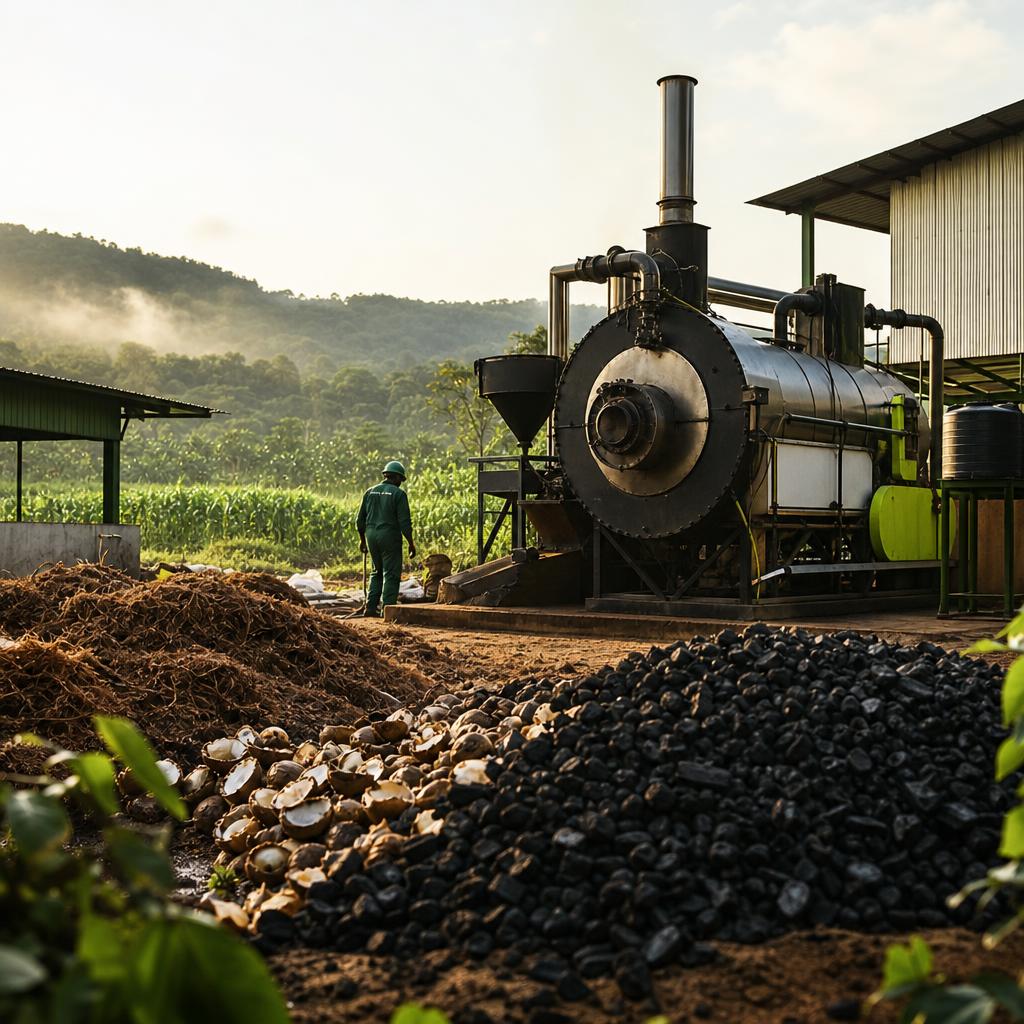
Processing produces residue, and residue in this part of the world is dry and high in carbon. Cashew shells. Palm kernel shells. Sawdust from timber mills. This material piles up at single sites, in steady quantities, week after week, and for most operators it is a cost rather than an asset. Some of it gets burned in the open, which is the worst possible outcome for everyone including the atmosphere.
Put that residue through pyrolysis, which means heating it with very little oxygen, and it becomes biochar. Biochar is stable. The carbon in it stays put for a very long time rather than returning to the air within a season.
The reason this matters for a state carbon plan is that it is the cheapest thing on the continent to verify. To check a forest carbon project you have to establish what would have happened to those trees without the project, which is a claim about a version of events that never occurred and which people argue about for years. To check a biochar project you weigh the shells going into the reactor and you weigh the biochar coming out. The evidence is physical, it stays physical, and anyone can recount it.
Nigeria has very few accredited verification bodies. In a country short of verifiers, the categories that are cheap to verify are worth more than the categories that are not.
Why it probably wasn't deliberate
I do not think anyone in Oyo decided against agricultural residue.
Look at the six again. Waste methane is on the list and livestock biogas is on the list, so this is plainly not a plan that overlooks waste. It is a plan that thinks about waste as something that escapes as a gas, which is how waste has been understood in climate policy for twenty years. Landfill gas and manure digesters are the established categories. Solid residue converted to a stable material is newer, and it does not look like a landscape and it does not look like a power plant, so it falls between the shapes a planner is reaching for.
The same thing happened at regional level two weeks ago. When ECOWAS set out where West Africa's carbon potential lies, the Commissioner for Economic Affairs and Agriculture named forests, agricultural land, mangroves and degraded landscapes. Every item on that list is a place. Twice in a month, in two documents drafted by different people at different levels of government, industrial residue simply did not come up.
That is a pattern, and patterns of omission are more fixable than patterns of opposition.
Worth noting
The Oyo plan is not a leaked draft. The state published it on its official website deliberately, and the Commissioner for Environment and Natural Resources, Ademola Aderinto, described it as a public tool for action, investment, funding and accountability rather than just a policy document. He asked stakeholders to study it and identify areas where they can contribute.
That is an unusual invitation from a state government and it deserves a straight answer rather than a complaint.
So here is the answer. Biochar Industrial Group installs pyrolysis equipment at agro processing factories at no upfront cost to the factory, converting residue that is already on site into biochar and verified carbon removal credits, with revenue shared with the host. The company works in Nigeria among other markets, and palm kernel shell is one of its named feedstock lanes.
The point is not that a particular company should be in a state plan. It is that a category should be, and that a state with this much processing capacity is leaving the easiest carbon it has out of its own pipeline.
Six is a good list. Seven would be a better one.