The most uncomfortable fact in this story is not that the projects were fake.
It is that they were checked.
On 21 August, Bloomberg reported that German authorities have revoked carbon credits from 30 projects in China. The projects had claimed roughly 2.1 million tonnes of carbon dioxide reductions, about what 500,000 cars emit in a year. Among the buyers was ExxonMobil, whose Belgian entity funded a project claiming nearly 96,000 tonnes at around 44 euros a tonne, a position worth about 4.2 million euros or 4.9 million dollars.
Some of those projects had been verified by three European auditing firms. The credits then entered a German compliance scheme where fuel suppliers could use them against domestic obligations. They sat there, valid, until they were not.
Companies holding the revoked credits must now make up the shortfall. They paid once for a tonne that turned out not to exist, and they will pay again for one that does.
What actually went wrong
The credits came from upstream emissions reduction projects, which claim to cut emissions during fossil fuel extraction. Verifying that kind of claim means confirming what happened at an oil or gas facility in another country, usually from documentation supplied by the people running it.
The German Environment Agency identified 45 projects as suspicious and eventually withdrew credits from 30. Its report names Beijing Karbon, a Chinese consultancy it identifies as the main developer behind the suspicious projects, and states that the company had through deception created the appearance of legitimate projects.
Bloomberg obtained the report through a freedom of information request. Of the 30 invalidated projects, details for 24 were redacted because investigations are continuing. Only six are named, and for those six the revocation decisions are final. Germany was one of at least nine European countries where credits from these projects were sold.
ExxonMobil told Bloomberg it operates within legal requirements and does not generally comment on ongoing investigations. That is a fair position. Nothing in the reporting suggests the buyers knew, and the German customs authority has previously said the offsets were bought in good faith. These were companies doing what the system told them to do.
The part that should worry a project developer
There is a version of this story that reads as a scandal about Chinese projects and European oil companies, and it is not very useful.
The useful version is about what verification can and cannot do.
An auditor checking an upstream emissions reduction project is assessing a claim about operations it does not control, at a site it visits briefly, using data that the project developer provides. If the developer is constructing an appearance rather than a reality, the auditor is checking the appearance. The process can be followed correctly and produce the wrong answer, which is roughly what seems to have happened here across multiple firms and multiple projects.
That is not an argument against verification. It is an argument that verification is only as strong as what is being verified, and that some things are much easier to verify than others.
A claim about what would have happened at a gas facility is hard. A claim about what did happen to a measurable quantity of material is not.
Why this matters more in Africa
European buyers can absorb a revocation. A 4.9 million dollar write-off at ExxonMobil is not a corporate event.
An African project developer cannot absorb the equivalent. If credits from a facility are invalidated three years after issuance, the developer is exposed, the host site that shared the revenue is exposed, and the next ten projects in that country become harder to finance regardless of their own quality. Reputational damage in carbon markets has never respected borders or been carefully allocated to the parties who deserved it.
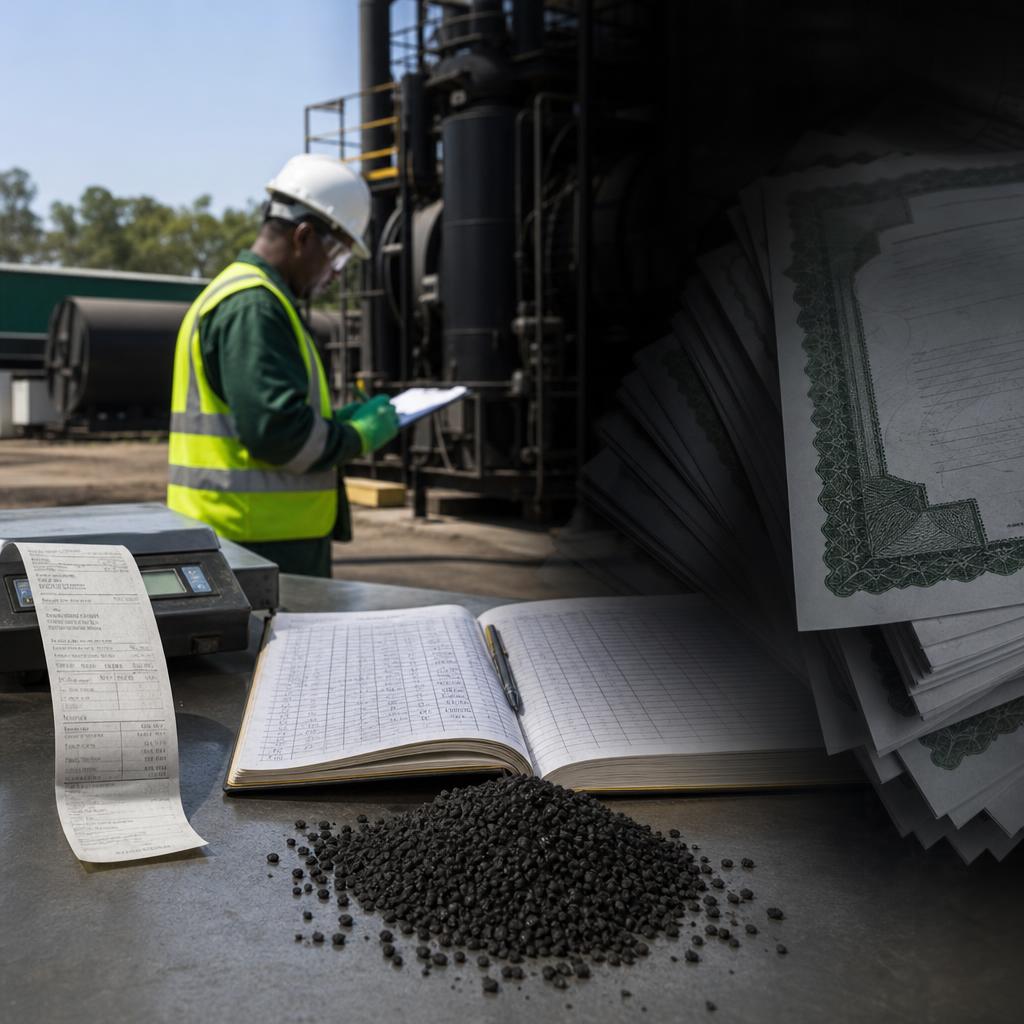
This is why the design question matters so much here. A project whose validity rests on a counterfactual or on somebody else's operational data carries a permanent tail risk. A project whose validity rests on weighing material carries much less of one, because the evidence still exists after the fact and can be recounted by anyone who turns up.
Biochar Industrial Group installs pyrolysis equipment at agro processing factories at no capital cost to the factory, converting residue already on site into biochar and verified carbon removal credits, with the revenue shared with the host. The reason we keep returning to the point about weighing is not marketing. It is that a regulator arriving in 2029 to reexamine a 2026 issuance will find scale records, production logs and a physical product, at a site with an address, rather than an argument about what an oil field might otherwise have emitted.
The question to ask now
Anyone buying, hosting or financing carbon credits should be asking a question that this week made unavoidable.
If a regulator reopened this issuance in three years, what would they find?
If the answer is a set of documents provided by somebody else about something that did not happen, that is a risk with no floor. If the answer is a weighbridge ticket, a production log and a pile of material, the exposure is a different order of magnitude.
Thirty projects passed. Then they did not, and the buyers are paying twice.