A factory manager in Ogun State told me last year that carbon credits were worth about a dollar a tonne and were mostly a way for European companies to buy their way out of trouble. He was half right, which is the problem. Almost everything people believe about this market is half right, and the half that is wrong is usually the half that matters.
Here are five of them.
1. The price is not one number
The most common thing people know about carbon credits is that they are cheap. This comes from a real figure. Average spot prices across the whole voluntary market sat at around 6 dollars a credit in 2025, and forest protection credits still trade near that level.
But that average is a mix of things that have almost nothing to do with each other. Sylvera's 2026 pricing work puts the average REDD+ forest credit at about 6 dollars and the average biochar credit at about 177 dollars. Other trackers put biochar somewhere between 100 and 250 dollars depending on the standard, the storage claim and when delivery happens.
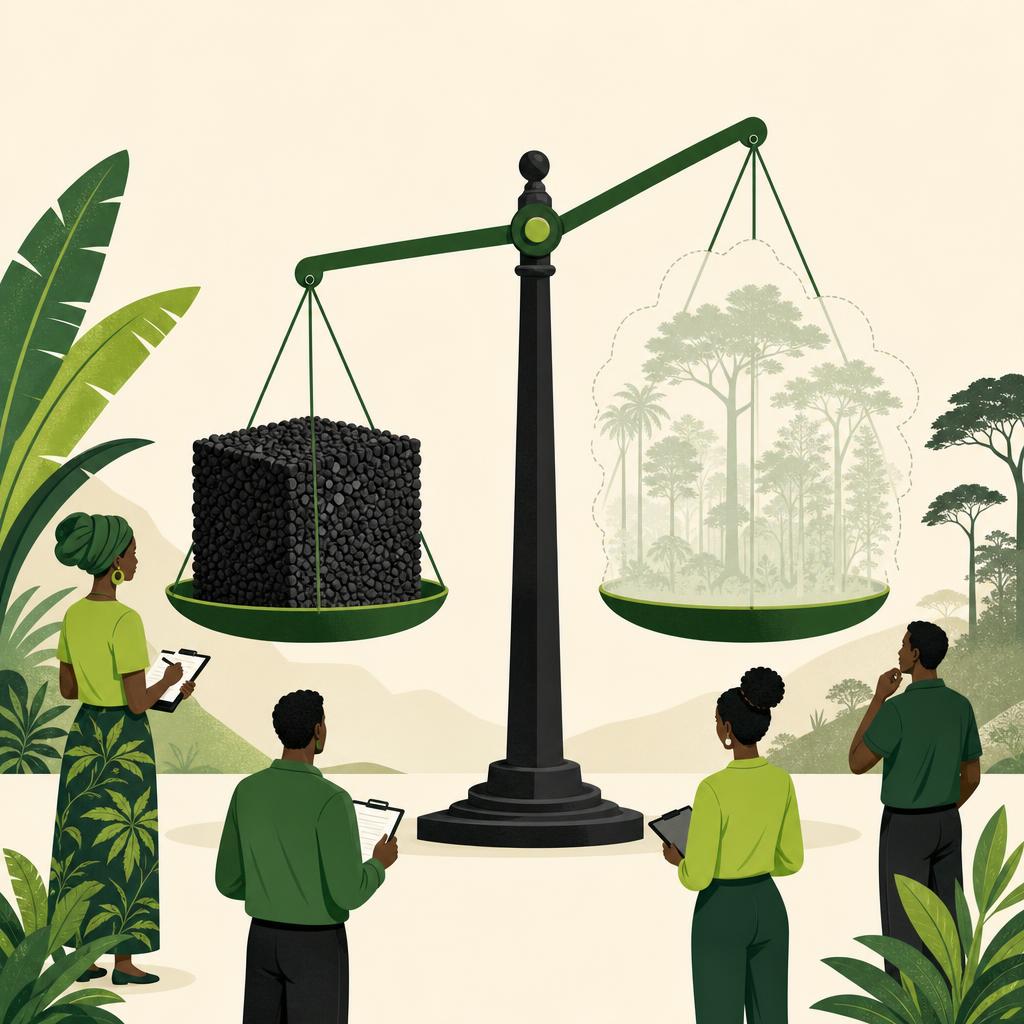
~$6average REDD+ forest credit price, Sylvera 2026 pricing data ~$177average biochar credit price — a 29× premium for carbon you can weighThe gap is not a market failure. It reflects what is actually being sold. A forest credit says something bad would have happened and did not. A biochar credit says a measured quantity of carbon was taken out of circulation and can be weighed. One of those is an argument. The other is a receipt.
So when someone says carbon credits are worth six dollars, the honest answer is that some are, and the ones that are tend to be the ones you cannot prove.
2. Owning the land does not mean owning the credits
This is the one that catches people out, and it has become sharper since Article 6 of the Paris Agreement started operating properly.
When Ghana sold cookstove credits to Switzerland, the transaction was not simply a sale. Ghana had to apply what is called a corresponding adjustment, which means adding those tonnes back onto its own national emissions account so that Switzerland could subtract them. By July 2025 Ghana had transferred 11,733 tonnes of these units. Ghana got the money. Ghana also gave up the right to count that reduction towards its own climate target.
That is a genuine trade, and reasonable people disagree about whether it is a good one. But it means a credit is not simply a thing you produce and sell. It is a claim, and someone has to give up the claim for someone else to take it. In several African countries the government now decides who is allowed to do that. Kenya published a rule book this month that caps international transfers at 10 million tonnes to 2030, with every request assessed against that ceiling.
If you generate credits on your own land and assume they are yours to sell abroad, you may be wrong in a way that only becomes clear at the point of sale.
3. The land question is real, but it is not universal
There is a serious version of the concern that carbon projects take land, and it is worth stating properly rather than dismissing.
In January 2025 the Kenyan High Court ruled in a case brought by 165 petitioners from Isiolo County that two conservancies associated with the Northern Rangelands Trust had been established without proper public participation, violating the constitutional rights of the petitioners including their property rights. The Northern Kenya Rangelands Carbon Project, which describes itself as the world's largest soil carbon removal project, covers 4.7 million acres and has sold credits to companies including Meta and Netflix. Pastoralist communities have argued that grazing restrictions attached to the project disrupt migration patterns they have used for generations.
That is a real dispute with a real court ruling behind it, and anyone who works in this market should be able to talk about it without flinching.
What does not follow is that every carbon project works this way. The disputes cluster around one specific model: large area land based projects where the carbon claim depends on how land is used and therefore requires changing how people use it. A project that takes a pile of shells sitting behind a factory and processes them on site does not involve anybody's grazing route. The category matters enormously and it almost never survives into the headline.
4. Some of it was a scam, and the industry knows which parts
The strongest version of the sceptical case is not that carbon markets are theoretically flawed. It is that specific credits were sold for carbon that was never actually saved, including for trees that were never at risk of being cut down.
That happened. Audits found it, buyers were left holding assets worth far less than they paid, and the reputational damage spread across the whole market including the parts that had nothing to do with forests.
The useful thing to understand is why it was possible. A forest protection credit rests on a prediction about what would have happened without the project. Predictions can be generous, and for years nobody had a good way to check them. That is a design weakness, not a moral failure of everyone involved, and the market has been slowly correcting for it. Buyers now pay a large premium for credits where the counting is physical rather than predictive, which is exactly what the price gap in the first section is measuring.
5. The buyers are fewer than you think
Most people assume there is broad corporate demand for carbon credits. There is not. There is concentrated demand, and this month everybody found out how concentrated.
BloombergNEF reported on 13 August that Microsoft bought 8.55 million tonnes of removal credits in the year to mid July, roughly 80 percent less than the same period in 2025, as it increased spending on artificial intelligence infrastructure. Its own emissions rose 25 percent in 2025. Microsoft still accounts for close to half of all removal transactions this year. Over the same period total global removal sales fell 66 percent, to 18 million tonnes.
−80%drop in Microsoft's removal credit purchases, year to mid-July 2026 vs the same period in 2025 −66%fall in total global removal sales over the same period, to 18 million tonnesOne buyer moved and the market dropped by two thirds. Anyone planning a project on the assumption that demand is a broad and rising tide should sit with that number for a while.
What this changes
None of this makes carbon revenue a bad idea. It makes it a specific idea, with a shape, and the shape is not what most people picture.
Biochar Industrial Group works at the narrow end of this. The company installs pyrolysis equipment at agro processing factories at no capital cost to the factory, turning residue that is already sitting on site into biochar and into verified removal credits, with the credit revenue shared with the host. At a palm processing site in Cross River State, Nigeria, 255.77 tonnes of palm nut shell produced 83.33 tonnes of biochar and 190 verified credits, which were sold to Salesforce and Klarna through Milkywire. Those were Nigeria's first verified industrial biochar credits.
The reason that project could be sold is the reason this whole article keeps circling. Everything in it was weighed. There is no argument about what would have happened otherwise, no land use question, and no prediction to dispute.
The question worth carrying is not whether carbon credits are real. It is which kind you are being offered, and whether anyone can weigh it.