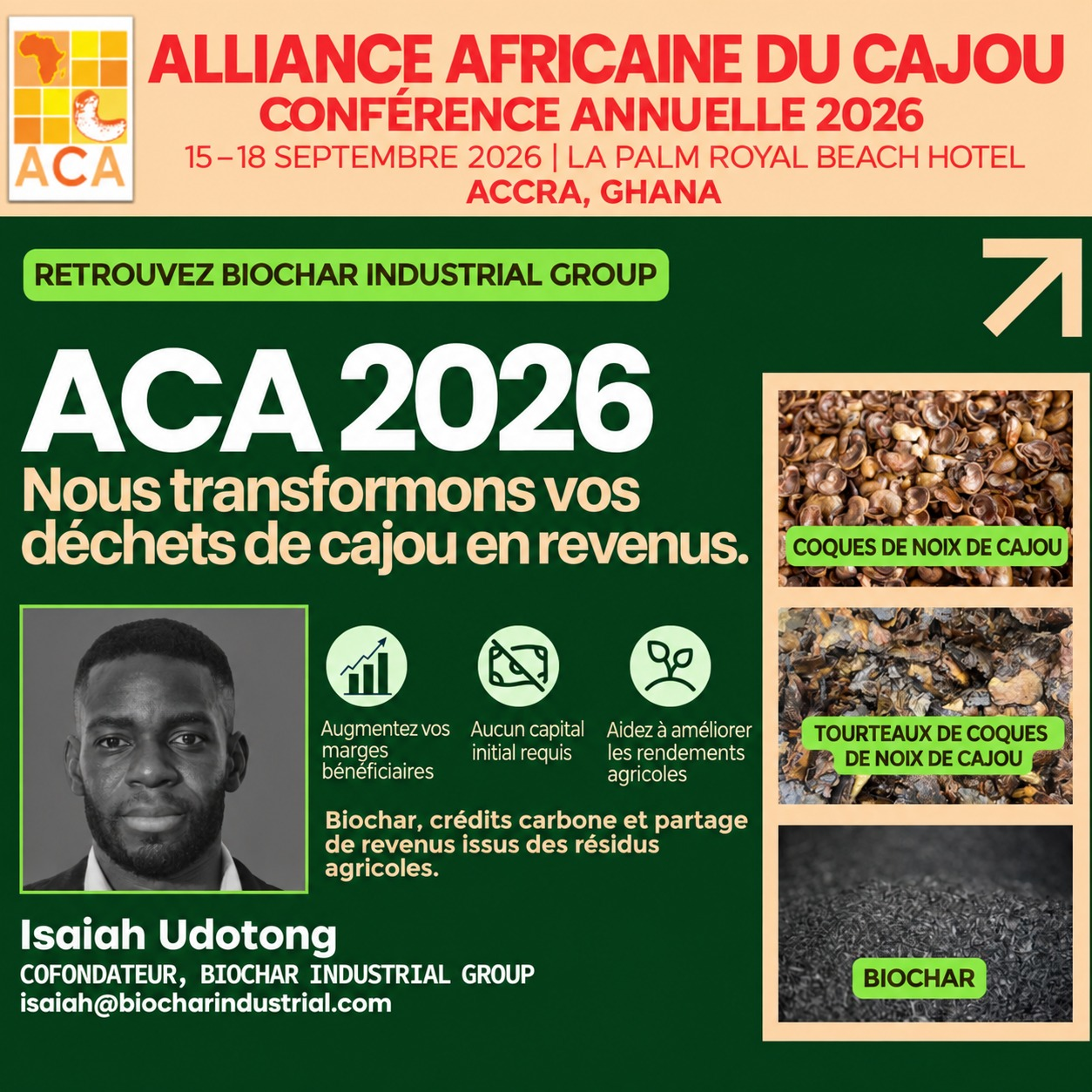
We are at the African Cashew Alliance conference in Accra this week.
Six hundred people. Thirty countries. Every major cashew processor in West Africa in one building.
One thing came up in almost every conversation we had on the floor today.
The shell problem
After the kernel leaves, the shell stays.
De-oiled cake after CNSL extraction has limited buyers. Where it sells, it moves at $50 to $95 per tonne. For most processors here, it is a cost to manage, not a line on the revenue side.
We built our first facility around this problem
Our first facility was built around exactly this problem, except with palm kernel shells.
For years at Releaf Earth in Cross River State, PKS was 50% of the mass we handled and barely 5% of our revenue. Some quarters we broke even. Some we went negative. Some we came out barely positive.
Then we added a pyrolyzer.
The same shells became biochar and verified carbon removal credits. Salesforce purchased 190 tonnes of credits from our facility earlier this year — Nigeria’s first industrial-scale carbon removal sale, through the Rainbow registry via Milkywire.
PKS is now among our highest revenue generators per tonne.
The same model works for cashew shell
The physics are the same. The registry is the same. The zero-upfront-cost partnership structure is the same.
Cashew shell does not have to remain a disposal problem. With the right facility design and commercial structure, it can become biochar, carbon removal credits, and a new revenue stream for the processor.
Are you at ACA this week?
If you are a cashew processor in West Africa and you are at ACA this week, find Isaiah Udotong on WhatsApp: +1 609 760 0741.
If you are not here, reply to this post or send us a message. Tell us your location and your annual shell volume. We will tell you what the numbers look like for your operation.
The shell is not a problem. It is the asset.