Ask biochar developers what stands between them and carbon-credit revenue in 2026, and the answer is no longer the machine, the feedstock, or the buyers. It is the evidence.
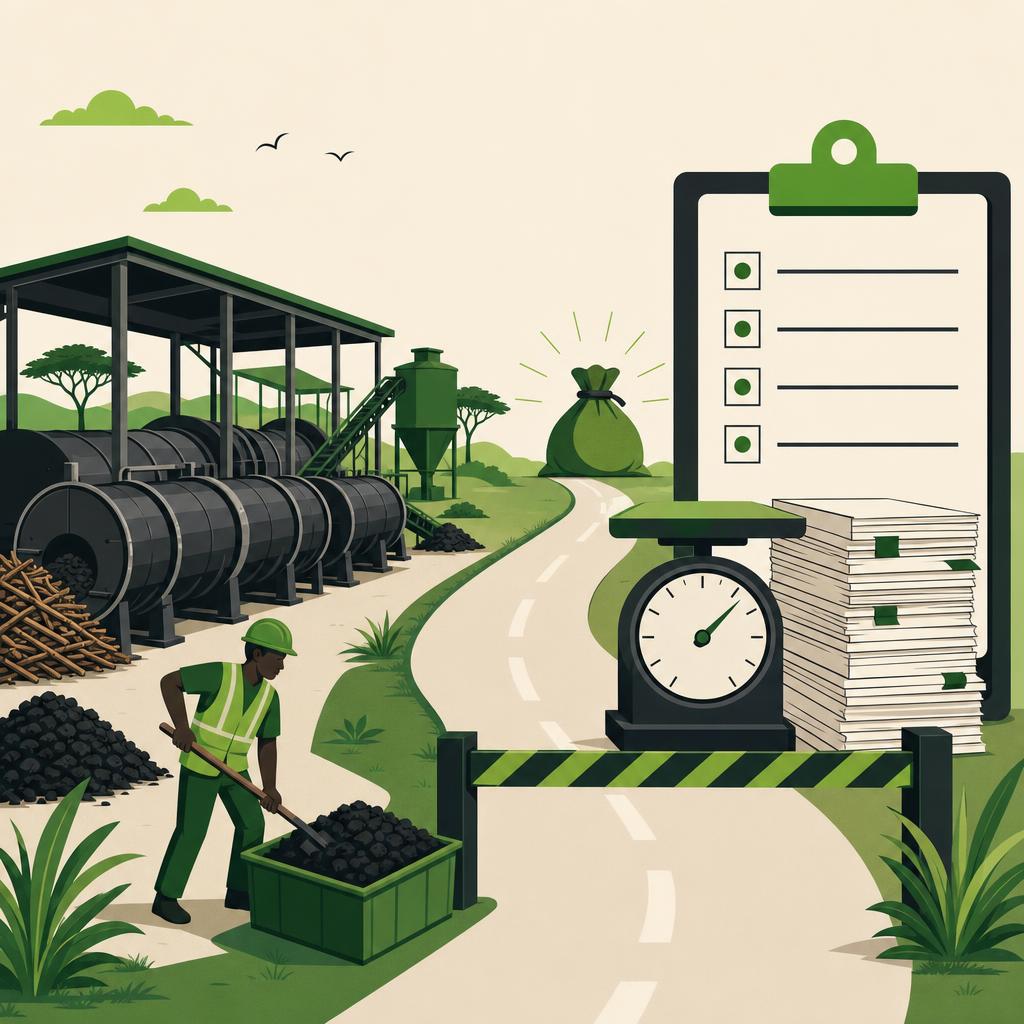
Measurement, reporting and verification — MRV, the paper trail that proves a tonne of carbon is really in the ground — has quietly become the industry's main bottleneck. A project can be running beautifully: reactor humming, char going into farmland, farmers coming back for more. And it can still earn nothing, because the records it kept do not meet what a registry and a buyer demand. The plant works. The paperwork doesn't.
That is a genuinely new situation. For years, the biochar conversation was about production: could you build a pyrolyzer that ran reliably, could you feed it, could you find someone to pay. Demand answered itself — buyers locked up over 90% of industrial supply through multi-year deals. Technology matured. Feedstock, especially in Africa, was never the constraint; it burns in heaps outside every mill. What is left is the hard, unglamorous middle: proving it.
Why Africa is especially exposed
Every biochar project on Earth faces the MRV squeeze. African projects face it twice.
First, the evidence bar itself keeps rising. Registries have tightened methodologies, and the sophisticated buyers who dominate the market do their own due diligence on top. A gap in your batch records is no longer something an auditor waves through with a note. It is a discount on your price, or a deal that quietly dies.
Second — and this is the African part — the continent has a real shortage of accredited verification bodies. The auditors who can sign off on a project are few, stretched, and often flown in. That means longer queues, higher costs per verification, and less room for the back-and-forth that fixes a marginal evidence package. When verification capacity is scarce, projects with clean, complete records go first. Everyone else waits. Some regional infrastructure is finally emerging — Kenya's national registry and exchange is a real step — but institutions grow slower than reactors get built.
Put those together and the conclusion is uncomfortable but clarifying: Africa's biochar constraint is institutional, not technical. Building more plants will not fix it. A hundred new pyrolyzers feeding into the same thin verification pipeline just makes the queue longer. The projects that win will be the ones engineered, from day one, to be easy to verify.
Evidence is a design decision, not an afterthought
Here is the mental shift: MRV is not a report you write at the end. It is a discipline you either run from the first batch or reconstruct, painfully and unconvincingly, months later. Auditors can tell the difference. Records created in real time — timestamped, boring, consistent — read as truth. Records assembled the week before a verification visit read as a story.
So before anyone talks about credit issuance, a project should honestly assess its MRV readiness. Not "do we make good char" but "could a stranger, using only our records, reconstruct what happened to every batch?" If the answer is no, that gap is worth more attention than any equipment upgrade — because registration lives or dies on exactly this trail.
What to capture from the very first batch
The good news: the list is not mysterious. For every batch, an auditable record should cover five things:
- Feedstock origin. Where the biomass came from, from whom, with what right to it. Supplier name, location, date, quantity, and evidence it was genuine waste — not diverted from another use, not linked to land clearing.
- Mass. Weights in and weights out. Actual scale readings, not estimates. The input-to-output ratio is one of the first things a verifier sanity-checks.
- Moisture. Moisture content of the feedstock at intake. It changes the real dry mass, and therefore the real carbon, in every downstream calculation. A cheap moisture meter and a logged reading per delivery is enough.
- Pyrolysis conditions. What the reactor was doing while the batch ran — temperature, duration, and any process upsets. This is what connects your char to the lab results that prove permanence.
- Final placement. Where the char ended up, with proof it stayed there: date, location, GPS pin, photos, and the receiving farmer or site. Char whose destination cannot be evidenced is char that never earns a credit.
Five fields, every batch, no exceptions. On paper if you must, in an app if you can — digital records with timestamps and photos are faster to verify and harder to doubt, and they are what lets a project scale past one site without drowning. This is also the operational heart of certification for agro-processors: the standard you certify against is, in the end, a promise about your records.
The uncomfortable, useful conclusion
"It's the paperwork" sounds like a complaint. It is actually the opportunity. The technical race in biochar is largely run; reactors are commodity enough. The evidence race is wide open, and it is winnable by discipline rather than capital. An operator in Nigeria or Côte d'Ivoire who logs those five fields from batch one holds something scarcer than char: a verifiable claim, in a market that has stopped paying for anything else.
Africa does not need to out-build the rest of the biochar world. It needs to out-document it.
Based on industry reporting, July 2026, on MRV as the primary constraint on biochar carbon-credit revenue, and on the state of verification capacity across African carbon markets.